What is Somatic Experiencing?
Somatic Experiencing (SE) is a psychobiological approach to trauma renegotiation and nervous system regulation, developed by Dr. Peter Levine.
This method is based on observing animal behavior in the wild when facing threatening situations, where the body is able to discharge stress without becoming traumatized. By applying this understanding to humans, Somatic Experiencing® helps restore the body’s natural ability to self-regulate after overwhelming experiences.
Somatic Experiencing® integrates principles from:
- Somatic education
- Body-oriented psychotherapy
- Neuroscience and trauma physiology
- The body-brain-mind connection
The goal is to help individuals reconnect with their bodies, release the energy trapped by trauma, and restore inner balance.
Although human beings possess practically these same resources, their use is often repressed, among other reasons, by the “rational” part of our brain. This prevents the complete discharge of the mobilized energy and makes it difficult for the nervous system, and with it the whole body, to return to a state of equilibrium. The unreleased energy remains in “high activation mode” and, because of that, the various symptoms of trauma that persist are a consequence of the body’s attempt to “manage” and contain this energetic overload.
It is important to note that the symptoms of trauma are not caused by the threatening event itself, but by the activated and unreleased energy. Thus, anxiety, insomnia, tiredness, excessive alertness, etc., appear. .
SE offers a safe and gradual way to “release” this energy through awareness of bodily sensations, thus helping people recover from trauma without reliving it.

"The body has been designed to renew itself through continuous self-correction.
This principle is also applicable to the psyche."
Peter Levine, Psychologist and Medical Biophysicist
What benefits does SE have?
Somatic Experiencing® is particularly effective in the treatment of post-traumatic stress, which can result from various situations such as: aggressions (physical, sexual, verbal, emotional), accidents (car, work, falls, etc.), drowning, invasive surgical procedures (especially when performed on children who are immobilised and/or anaesthetised), poisoning, prolonged immobilisation, serious illnesses, experiencing or witnessing violent events, effects caused by traumas in the development of the psychological structure, etc.

By directing awareness to the body, one's own innate resources are accessed, allowing high activation to be released, achieving not only a considerable reduction in activation, but even the complete disappearance of traumatic symptoms. The person regains vitality, presence and the ability to be in the here and now.

It favours a greater connection with one's own body, which allows one to act with greater coherence from the ‘body-mind-spirit’ relationship. This leads to greater self-respect in various aspects of vital importance such as: ‘what are my needs’, ‘how do I set healthy limits’, ‘how do I take care of myself or how do I develop a greater capacity for self-restraint’, etc.

It helps to discover how the Nervous System works and teaches how to ‘self-regulate’, for example, how to calm down if you are nervous, how to understand the language of the body and pay attention to it, or how to discover patterns of behaviour and thought that have become ‘stuck’ and how to get out of them consciously and effectively.
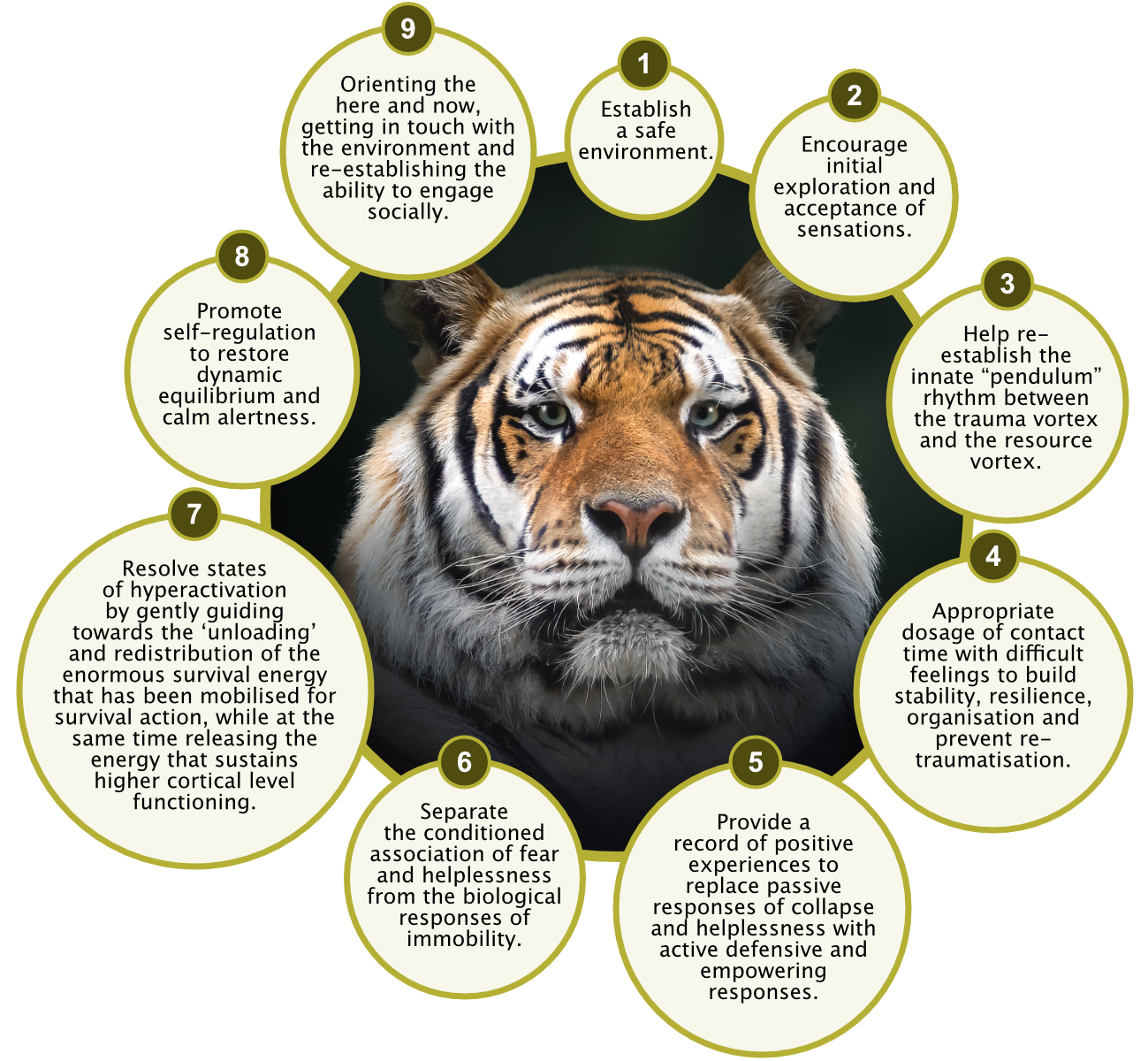
The nine
pillars of
SOMATIC EXPERIENCING